


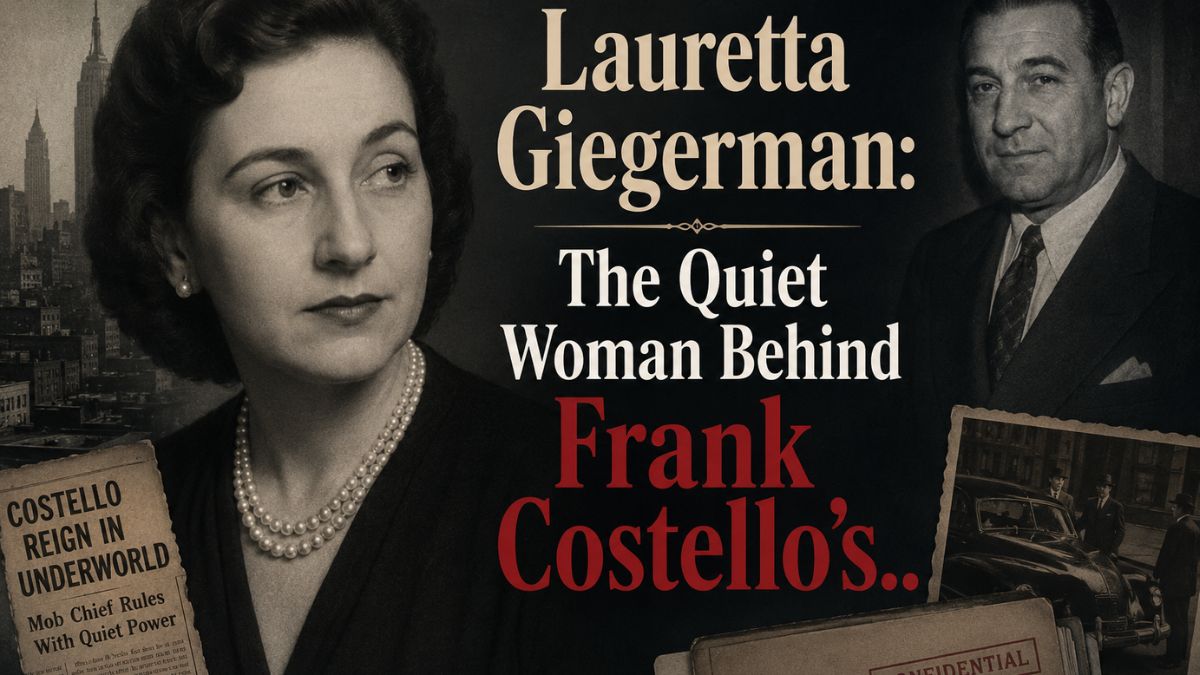
History often remembers powerful and controversial figures while overlooking the people who stood beside them. One such person is Lauretta Giegerman, a woman whose life became closely connected to one of America’s most famous organized crime figures, Frank Costello. Although Costello’s name frequently appeared in newspapers, court records, and history books, Lauretta Giegerman remained largely out of the public eye.
- Early Life and Family Background
- A Career in Entertainment
- Meeting Frank Costello
- Marriage and a Lifelong Partnership
- Living Away From the Spotlight
- The Costello Household
- The 1957 Assassination Attempt
- Loyalty Through Decades of Turmoil
- Frank Costello’s Death and Lauretta’s Later Years
- Why Lauretta Giegerman Remains Interesting Today
- Conclusion
Her story is not one of crime, power, or public fame. Instead, it is a story of privacy, loyalty, resilience, and a remarkable ability to maintain a quiet life despite being married to one of the most influential figures in organized crime history. Today, growing interest in historical personalities has led many people to search for information about Lauretta Giegerman and the role she played behind the scenes.
Early Life and Family Background
Lauretta Giegerman was born on October 28, 1894, in Manhattan, New York. Historical records suggest she came from a German-Jewish immigrant family. Her parents, Jacob H. Geigerman and Cecelia Josephs, were part of the large immigrant communities that helped shape New York City during the late nineteenth century.
Growing up in Manhattan during this period meant experiencing a city undergoing rapid growth and cultural transformation. While detailed information about her childhood and education remains limited, available records indicate that she was raised in a family that valued hard work, family ties, and cultural traditions. These influences likely contributed to the reserved and disciplined personality that later defined her life.
Unlike many individuals associated with famous historical figures, Lauretta left behind very few personal records. There are no known memoirs, extensive interviews, or public statements. This absence of information reflects her lifelong commitment to privacy.
A Career in Entertainment
Before becoming known as Frank Costello’s wife, Lauretta reportedly spent time working in New York’s entertainment world. Several historical accounts describe her as a vaudeville performer or showgirl who used the nickname “Bobby” during her stage career.
The entertainment industry in early twentieth century New York offered opportunities for ambitious young women seeking independence and financial stability. Vaudeville theaters were immensely popular, attracting large audiences and providing performers with exposure to diverse social circles.
Although detailed records of Lauretta’s performances have not survived, her experience in show business may have helped her develop confidence, social skills, and adaptability. These qualities would later prove valuable as she navigated life alongside a man whose name attracted constant public attention.
Meeting Frank Costello
The exact circumstances surrounding Lauretta Giegerman’s meeting with Frank Costello remain uncertain. Different accounts offer varying explanations, with some suggesting they were childhood acquaintances while others claim they met through mutual friends. What historians generally agree upon is that their relationship began before Costello became one of the most powerful figures in organized crime.
At the time, Frank Costello was still building his reputation within New York’s underworld. Born Francesco Castiglia in Italy, he immigrated to the United States as a child and gradually became involved in organized crime. Over time, he would earn the nickname “The Prime Minister of the Underworld” because of his political influence and strategic approach to criminal enterprises.
Their relationship developed during a period of significant social and economic change in New York City. As Costello’s influence expanded, Lauretta remained a steady presence in his life.
Marriage and a Lifelong Partnership
Most sources indicate that Lauretta Giegerman and Frank Costello married around 1918, though some records suggest slightly different dates. Regardless of the exact year, their marriage lasted for more than five decades, ending only with Costello’s death in 1973.
Their relationship stands out because long-lasting marriages were relatively uncommon within the volatile world of organized crime. Costello faced numerous legal investigations, political inquiries, and criminal conflicts throughout his career, yet his marriage remained remarkably stable.
Friends and observers often described Lauretta as a calming influence. While Costello managed complex criminal and political relationships, Lauretta focused on maintaining a private and orderly home life. Together, they created a partnership that endured despite the pressures surrounding them.
Living Away From the Spotlight
One of the most fascinating aspects of Lauretta Giegerman’s life was her determination to avoid public attention. Unlike many spouses of famous or controversial figures, she rarely appeared in newspapers and almost never gave interviews.
Even as Frank Costello became a household name during congressional investigations and media coverage of organized crime, Lauretta remained largely invisible. She did not seek fame, political influence, or public recognition. Instead, she concentrated on maintaining a peaceful domestic environment.
This decision was likely intentional. Living in the public eye can be exhausting, especially when connected to someone facing constant scrutiny. By remaining private, Lauretta protected both herself and her family from much of the attention directed toward her husband.
The Costello Household
The Costellos reportedly lived comfortably in Manhattan and maintained a residence in Sands Point on Long Island. Their lifestyle reflected Frank Costello’s considerable wealth, but accounts suggest their home life was more restrained than many might expect from a prominent crime figure.
The couple did not have children, a fact often noted in biographies of Frank Costello. Without the responsibilities of raising a family, Lauretta devoted her attention to managing the household and supporting her husband through various challenges.
Visitors frequently described their home as organized, welcoming, and surprisingly normal considering Costello’s public reputation. Lauretta played a significant role in creating that atmosphere.
The 1957 Assassination Attempt
One of the most dramatic moments in Lauretta’s life occurred on May 2, 1957, when Frank Costello survived an assassination attempt. Gunman Vincent Gigante shot at Costello outside their Manhattan apartment building, but the bullet only grazed his head. Costello survived and later identified the attacker.
The event briefly pushed Lauretta into the public spotlight. Photographers captured images of her leaving the hospital and accompanying her husband during police questioning. Yet even during this highly publicized incident, she remained consistent with her lifelong preference for privacy.
After the immediate crisis passed, Lauretta returned to her quiet lifestyle, avoiding media attention and public commentary.
Loyalty Through Decades of Turmoil
Throughout Frank Costello’s career, Lauretta remained by his side. She witnessed his rise to power, his interactions with politicians and law enforcement, his legal battles, and his eventual enterment from organized crime activities.
Many historians view her loyalty as one of the defining characteristics of her life. While others sought publicity or financial advantage, Lauretta appeared content with maintaining stability and discretion.
Her commitment to privacy also makes her somewhat unique among figures associated with organized crime. Unlike many mob spouses who became public personalities or cooperated with authorities, Lauretta left behind almost no public record of her personal opinions.
Frank Costello’s Death and Lauretta’s Later Years
Frank Costello died from a heart attack on February 18, 1973, at the age of 82. His death marked the end of an era in American organized crime.
What happened to Lauretta afterward remains somewhat unclear. Historical records confirm that she survived her husband, but precise details about her later years are limited. Researchers have struggled to locate definitive records regarding her death, contributing to the mystery that surrounds her life.
This lack of information is fitting in a way. Lauretta spent her entire adult life avoiding publicity, and even after her husband’s death, she continued to remain outside public view.
Why Lauretta Giegerman Remains Interesting Today
Interest in Lauretta Giegerman continues because she represents a different side of history. While countless books, films, and documentaries focus on crime bosses and political power, fewer stories examine the individuals who lived alongside those figures.
Her life highlights themes that remain relevant today: privacy, loyalty, personal identity, and resilience. She lived through major historical events, experienced extraordinary circumstances, and shared her life with one of America’s most notorious crime figures, yet she managed to preserve her own sense of independence and discretion.
In an age where public visibility is often valued above all else, Lauretta Giegerman’s story stands as a reminder that some people choose a different path.
Conclusion
Lauretta Giegerman may never become as famous as Frank Costello, but her story offers valuable insight into a hidden chapter of American history. Born into an immigrant family, briefly involved in entertainment, and ultimately married to one of the most influential crime bosses of the twentieth century, she lived a life defined by privacy and steadfast loyalty.
Although many details about her remain unknown, the information that survives paints a picture of a woman who deliberately stayed out of the spotlight while navigating extraordinary circumstances. Her quiet strength, commitment to family, and refusal to seek attention have made her an increasingly fascinating figure for historians and readers alike.
Today, Lauretta Giegerman remains a symbol of the untold stories that often exist behind history’s most famous names.