


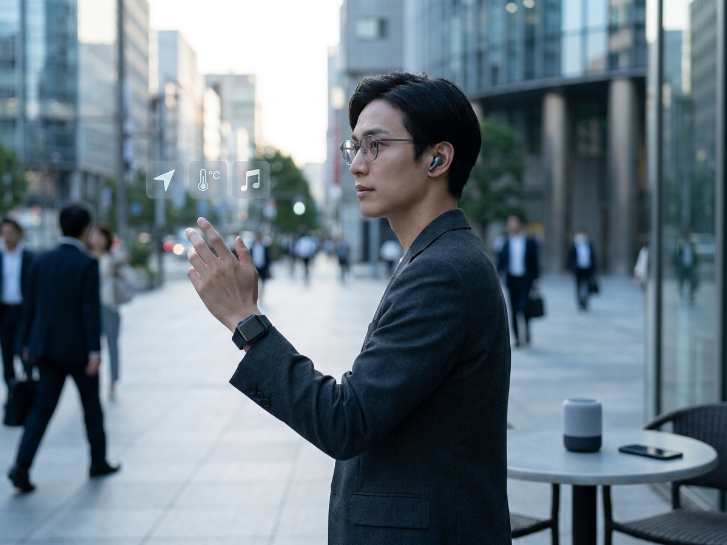
The smartphone isn’t disappearing anytime soon, but some of the world’s biggest technology companies are clearly preparing for a future in which it is no longer the only device people rely on.
- What Is Happening Beyond Smartphones?
- Why Are Tech Companies Looking Beyond the Phone?
- Meta Is Betting Heavily on AI Glasses
- Google Wants AI to Follow Users Into the Real World
- Apple Is Taking a Different Route
- The Next Generation of Smartphones May Not Replace Them
- AI Could Be the Real Platform Shift
- Privacy Could Decide Whether Wearables Succeed
- What Happens Next?
- The Future May Be Less About the Device
Meta is pushing AI-powered glasses, Google is developing Android XR and intelligent eyewear, while Apple is expanding Apple Intelligence across its devices and continuing to invest in spatial computing. Together, these moves point toward a broader shift in the future beyond smartphones, where people could interact with technology through glasses, voice, artificial intelligence and other connected devices.
The change isn’t happening overnight. In fact, the smartphone remains the central hub for many of these technologies. But the direction of travel is becoming easier to see: technology companies want computing to become more natural, less dependent on a screen and increasingly available wherever the user happens to be.
What Is Happening Beyond Smartphones?
For more than a decade, the smartphone has been the main gateway to digital life. Messaging, maps, photography, shopping, entertainment, banking and social media have all been built around the touchscreen.
Now technology companies are experimenting with interfaces that can perform some of those tasks without requiring users to pull out a phone.
Smart glasses are one of the most visible examples.
Google said in May 2026 that its Android XR platform would support intelligent eyewear capable of providing directions, sending messages and taking photos without users needing to take out their phones. The company also announced partnerships with eyewear brands including Gentle Monster and Warby Parker.
Meta has taken a similar approach. Its Ray-Ban Meta and Oakley Meta products combine traditional eyewear with cameras, audio and Meta AI. Meta says millions of its AI glasses have already been sold, indicating that wearable AI is moving beyond the experimental stage.
These products aren’t full replacements for smartphones yet. They are better understood as another layer of computing that can work alongside a phone.
That distinction matters.
Why Are Tech Companies Looking Beyond the Phone?
Smartphones have become extremely capable, but their basic design hasn’t changed dramatically in years.
A rectangular screen remains the primary interface. Users hold it in their hands, look down at it and interact with apps through touch.
The next major opportunity could be to make computing less visible.
Instead of opening an app to get directions, a person could receive guidance through glasses. Instead of typing a search query, they could ask an AI assistant a question aloud. Instead of constantly checking a calendar, an AI system could provide relevant information when it is needed.
This concept is sometimes described as ambient computing. The idea is that technology works in the background and responds to the user’s context rather than requiring constant attention.
Artificial intelligence makes that concept considerably more practical.
Modern AI systems can understand voice, images and increasingly complex requests. That gives wearable devices a more useful interface than older smart glasses or voice assistants had.
Meta Is Betting Heavily on AI Glasses
Meta is currently one of the clearest examples of a company trying to establish a new category around wearable technology.
Its partnership with EssilorLuxottica has produced Ray-Ban Meta glasses, while Oakley Meta products target users interested in performance and sports. The glasses can use Meta AI through voice commands and offer features including cameras, audio and hands-free assistance.
Meta has also highlighted accessibility as a potential benefit.
The company says its AI glasses can help people with disabilities by providing hands-free assistance and helping users understand their surroundings. In June 2026, Meta announced a programme to provide Ray-Ban Meta glasses to blind veterans in the United States.
That illustrates why AI wearables could be more than another consumer electronics category.
A camera, microphone, speaker and AI assistant positioned on a person’s face can provide information without requiring them to hold a screen.
But the same technology creates difficult questions about privacy.
Google Wants AI to Follow Users Into the Real World
Google’s approach is closely tied to Android XR, its platform for extended-reality devices.
At Google I/O 2026, the company showed intelligent eyewear designed to provide information while users remain engaged with their surroundings. Google says these glasses can handle tasks such as directions, messaging and photography.
The company is also developing the wider Android XR ecosystem with Samsung and Qualcomm.
That matters because Google’s strength isn’t simply hardware. Its search, Maps, Gemini AI, Android and other services could give wearable devices access to a large collection of information and software.
The bigger idea is that the user’s digital assistant doesn’t have to live inside a phone.
It could potentially move between a phone, glasses, headphones, watches and other connected devices.
Apple Is Taking a Different Route
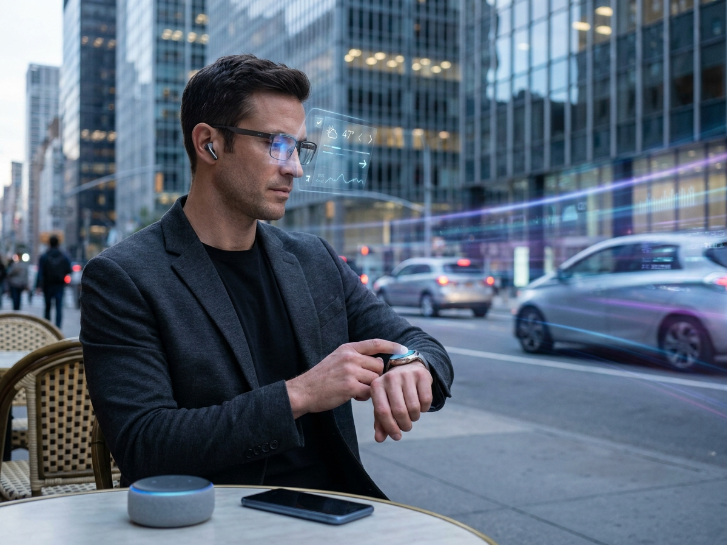
Apple hasn’t announced a direct replacement for the iPhone, but its software strategy shows where the company sees computing heading.
At WWDC 2026, Apple introduced the next generation of Apple Intelligence and a significantly upgraded Siri AI experience. The technology is being integrated across iPhone, iPad, Mac, Apple Watch, Vision Pro and Apple’s other platforms.
This is important because Apple isn’t treating AI as a feature belonging to one product.
Instead, it is becoming a layer that connects the company’s hardware ecosystem.
Apple’s Vision Pro also represents another possible direction for the future of mobile technology. Rather than looking at a small screen in your hand, spatial computing places digital content into a user’s physical environment.
Whether headsets become mainstream is still uncertain. They are larger and more expensive than smartphones, and many consumers may not want to wear them for long periods.
Glasses could offer a more natural alternative if manufacturers can make them light, comfortable and socially acceptable.
The Next Generation of Smartphones May Not Replace Them
The phrase “post-smartphone era” can be misleading.
The next major technology breakthrough may not involve abandoning smartphones altogether.
Instead, phones could become the central computing hub while other devices handle specific tasks.
For example:
| Device | Possible role |
|---|---|
| Smartphone | Main computing and communication hub |
| AI glasses | Visual information, navigation and hands-free AI |
| Smartwatch | Health, notifications and quick interactions |
| Earbuds | Voice-based AI and communication |
| XR headset | Gaming, work and immersive experiences |
| AI assistant | Understanding requests and coordinating services |
In this model, the phone doesn’t disappear. It becomes less visible.
A person might use glasses for directions, earbuds for a conversation with an AI assistant and a watch for quick notifications, while the smartphone handles more demanding tasks in the background.
That could be a much more realistic path than one device suddenly replacing the iPhone or Android phone.
AI Could Be the Real Platform Shift
The biggest change may not actually be hardware.
It could be artificial intelligence.
Smartphones became powerful because apps gave people access to countless services. AI could change that model by allowing users to describe what they want instead of deciding which app to open.
Imagine asking an assistant to find a restaurant, check its availability, arrange transportation and add the appointment to your calendar.
The user doesn’t necessarily need to think about which applications are involved.
The AI handles the interaction.
That is one reason major technology companies are investing so heavily in AI assistants and agent-style systems.
The interface could gradually shift from “open an app and operate it” toward “tell the system what you need and let it complete the task.”
Privacy Could Decide Whether Wearables Succeed
There is a major obstacle to the future of AI-powered wearable devices: people have to trust them.
Smart glasses can contain cameras and microphones. That means the technology can potentially observe environments and people who aren’t wearing the device themselves.
This has already generated criticism around Meta’s smart glasses. Concerns have included covert recording, consent and the possibility of people being filmed without realizing it.
The challenge is particularly complicated because cameras are also one of the most useful features of AI glasses.
A device that can “see” what the user sees can potentially answer questions about objects, signs, locations and surroundings.
But the same capability raises obvious privacy concerns.
Technology companies will therefore need to make recording indicators, privacy controls and social expectations part of the product design rather than treating them as afterthoughts.
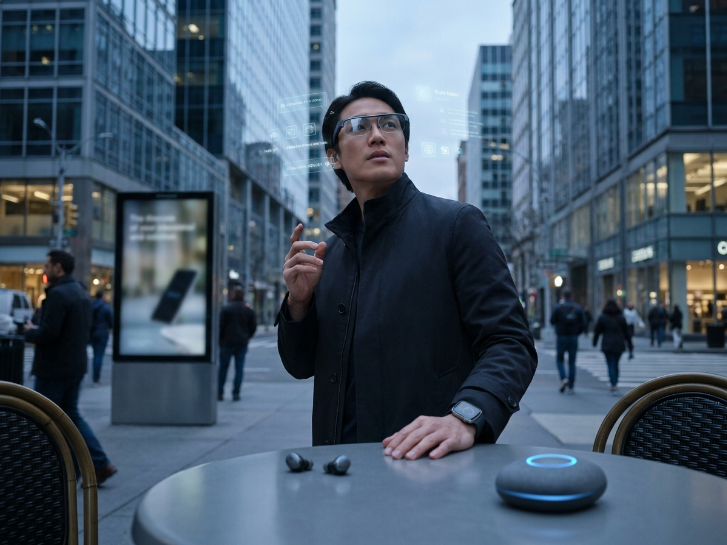
Probably not in the immediate future.
Today’s smart glasses still have limitations involving battery life, computing power, displays, connectivity and social acceptance.
Some products also depend heavily on a smartphone for their broader functionality.
There is another challenge: people already understand how to use phones.
A new device has to offer a meaningful advantage before consumers will change their habits.
Smart glasses may succeed first by handling small tasks that are annoying on a phone rather than trying to replace everything.
Checking directions, translating a conversation, identifying something in front of you, capturing a quick image or asking an AI assistant a question are all examples where hands-free interaction can make sense.
What Happens Next?
The next few years will probably be less about one company launching a “phone killer” and more about competing ecosystems.
Meta has an early lead in consumer AI glasses and is expanding its partnerships and product range. Google is building Android XR and preparing intelligent eyewear with Gemini. Apple is strengthening AI across its existing ecosystem while its spatial-computing platform provides another possible foundation for future interfaces.
The companies will also have to solve problems that smartphones didn’t face in quite the same way.
Wearables are personal and physically close to the user. A phone can be put in a pocket. Glasses remain on someone’s face and can potentially observe the world around them.
That makes privacy, battery life, comfort, safety and social acceptance just as important as processor speed.
The Future May Be Less About the Device
The most interesting possibility is that the next stage of computing won’t be defined by one particular gadget.
The smartphone era succeeded because one device combined communication, computing, cameras, entertainment and internet access.
The next era could distribute those functions across several devices, with AI acting as the connection between them.
That would make the future beyond smartphones less about replacing the phone and more about reducing our dependence on constantly looking at one.
For consumers, that could mean fewer moments spent staring at screens and more interactions that happen through voice, vision and context.
For technology companies, it represents a huge new competition over who controls the interface between people and AI.
The smartphone may still be here for many years. But the race to determine what comes after it has already begun.
FAQs
1. Are smartphones going away soon?
No. Smartphones are still central to communication, apps and digital services. The likely change is that other devices will increasingly work alongside them.
2. What is the future beyond smartphones?
The future beyond smartphones could involve AI-powered glasses, smartwatches, earbuds, XR headsets and AI assistants that let people interact with technology without constantly using a phone.
3. Which tech companies are developing smartphone alternatives?
Meta, Google and Apple are among the major companies investing in technologies such as AI glasses, extended reality, artificial intelligence and new forms of human-computer interaction.
4. How could AI glasses replace some smartphone functions?
AI glasses could provide directions, answer questions, translate information, take photos and offer hands-free assistance without requiring users to take out their phones.
5. Will smart glasses replace the iPhone or Android phones?
Probably not in the near term. Current smart glasses still have limitations around battery life, displays, computing power and privacy. They’re more likely to complement smartphones initially.
6. What is ambient computing?
Ambient computing is the idea that technology works naturally in the background and provides assistance when needed instead of requiring users to constantly interact with a screen.
7. Why is privacy a concern with AI-powered wearable devices?
Devices such as smart glasses can include cameras and microphones. This raises questions about recording people without their knowledge, data collection and how companies protect information.
8. What could technology after smartphones look like?
It could be a connected ecosystem of glasses, watches, earbuds, AI assistants and other devices, with artificial intelligence coordinating many tasks between them.